Aleksey Chernobelskiy
•August 24, 2025
Last mile LP risk
The overlooked challenges in the final stretch of a syndication
Happy Sunday!
When you invest in a real estate syndication, there is a critical period between the time you wire your funds and when the GP actually closes on the deal.
For LPs, this moment is typically ignored because it’s “quite simple” - either they’ll investment my money or I’ll get it back … right?
After advising on dozens of counter examples, I’d like to spend some time on (1) why the statement above isn’t really true and (2) what GPs/LPs can do to avoid missed expectations and even litigation.
Let’s start with a quick summary of events to define what we’re dealing with:
LP is shown a deck and wires cash based on that deck
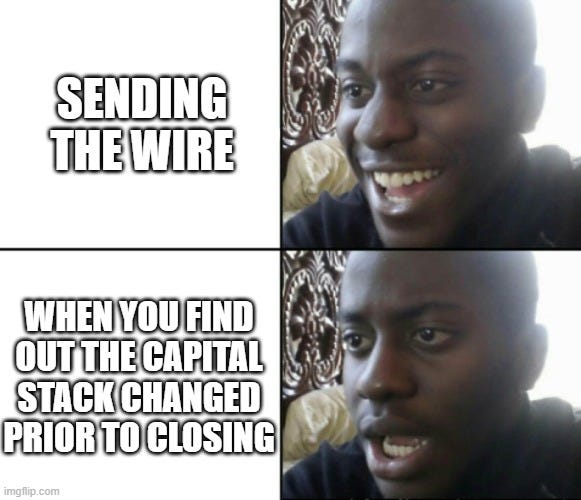
Between the time of the wire and close of escrow on the property something changes
Should the GP inform the LP about the change? Are they required to and is it “material enough” to warrant that level of communication?
Before I go further, it’s important to note that while I’ll cover some of the legal and practical aspects of what I’ve seen ~all of this ultimately hinges on (1) your relationship with GP, (2) the level of GP experience, and (3) the GP’s ethics:
Your relationship with GP - investors with more at stake and a closer relationship are typically treated differently. They shouldn’t be in terms of disclosure, but many times they practically are even if they didn’t negotiate side letters.
The level of GP experience - the more closings the GP has been in, the better handle on materiality they’ll have. An inexperienced manager might think something isn’t a big deal when it actually is.
The GP’s ethics - when you’re under the gun to close and something clearly changed, it’s tough to let go of the contract and lose your earnest money. This money comes out of the GP’s pocket (although we’ll come back to this soon) and we would delusional to not say that there can be a real “tug of war” between doing the right thing and just letting things slip in such circumstances.
Let’s dive into what changes most commonly prior to close:
**Debt changes **- a lender that quoted favorable terms weeks earlier may pull back or increase spreads at the last minute. In some cases, the lender may lower the leverage amount, forcing the GP to scramble for more equity. That change (or perhaps a change from a fixed rate loan to a floating rate loan) can materially alter the risk profile of an investment.
Across all of these, ensure you understand what (if anything) requires disclosure. Something like promising to get a rate cap to LPs and not getting one prior to close, or moving from a fixed loan to a floating rate loan should generally require disclosure.
**New equity partners - **when a GP struggles to complete a raise, they may bring in another equity source at the last minute (e.g. a JV partner or preferred equity investor). While this might save the deal from collapsing, it often shifts the risk profile for you as a “simple” LP.
On the pref equity side, the agreement should specifically stipulate whether there’s required disclosure to investors should something like this happen prior to close. It’s easy to sell a pref to LPs as “you’ll get higher returns” and in a good scenario the piece just acts as additional leverage so that’s true — but when things don’t go the expected way, this preferential position can wipe out your entire investment far quicker than you anticipated.
To be fair, a great JV partner can bring a lot to a partnership and could even look out for your best interests since they have their own stakeholders to protect. However, their agreement will typically come with terms that you’d never get - such as being able to force a sale or stop a sale from occurring. Usually you’ll see the JV partner’s best interests align with yours, but there will be times when the interests are at odds.
Across any capital stack changes, I would deeply recommend to take a look at the documents you’re signing - if it doesn’t say anything on disclosure in events of adverse changes, don’t hesitate to ask the GP why not. You’re wiring cash for the deal they put in front of you, not an altered one!
Unexpected DD findings - structural problems, environmental hazards, tenant delinquencies, or insurance or property tax budget shortfalls. While GPs typically underwrite reserves for surprises, a significant issue can reduce projected returns and it’ll be on them to warn you about this if the issue is material enough.
**Pursuit cost surprise - **if the legal document isn’t clear, there’s a rare but real possibility that your wired funds could be used for pursuit costs (hard money / earnest money deposit) rather than the property acquisition itself. Pursuit costs include legal, due diligence, or consulting fees tied to the failed transaction. In a worst-case scenario, if the deal doesn’t close, some of your capital might already be spent instead of returned in full. This is definitely not market and you should ensure you understand what you’re signing.
As always, I hope this helps you and look forward to your feedback!
When you’re ready, I could help you in 3 ways - simply reply to this email if one is of interest:
Limited Partners:
***GP-LP Match - ***a simple way for you to get more deal-flow that matches your precise LP parameters. You can join here in under a minute.
Potential positions - you’re considering investing and need an independent opinion
Existing positions - there’s a lack of communication, you’re concerned about fraud, or perhaps you got a capital call request and you’re not sure how to proceed. I have also helped LPs with a “post-mortem” analysis on deals that didn’t work out - it’s important to learn these lessons as opposed to just blaming the GP.
LP Course - review 4 separate memos in 4 weeks together with me and other LPs to learn how to find good LP investments.
LP Topics Seminar** - **an ongoing biweekly 1 hour meeting with other LPs where we'll go over investment decks, capital calls, distressed situations, and modeling. This is meant to provide a deeper look into existing LP investments. Please reply to this email if you’re interested.
***LP Community - ***free 2,800+ member LP Investor community on Twitter
***Find GPs ***in unique asset classes/geographies on my monthly intro post (see LinkedIn’s post as well for more)
General Partners:
Deck review - I’ll look over your marketing materials from the perspective of an LP and provide slide by slide commentary to improve your pitch
Investment review - I’ll provide independent feedback on an opportunity you’re pursuing
Capital call advisory** - **you suspect that you’ll need to make a capital call, but aren’t sure how to proceed or communicate the message.
Other - anything from waterfall/fee advisory to disagreements between co-GPs on the proper path given a set of circumstances
General Consulting: modeling, strategic advisory, underwriting training, etc.
If you’d like to speak on the phone, you can reach me at aleksey@centriocapital.com.
Join GP-LP Match
Sign up, then tell Sloan, our concierge, what you invest in. Sloan brings you sponsors whose raises fit, and your identity stays private until you say yes.
Message SloanNo cut of the capital you deploy.