Aleksey Chernobelskiy • September 8, 2025
Two concerning trends
New risks emerging in retail syndications
Happy Sunday!
When I was in college, many of my peers went to intern for Northwestern Mutual. On the surface, it looked like a “real” internship. In practice, it was more about selling insurance to friends and family (by the way later in life I did realize how important learning sales was, but that’s not the topic for today).
The problem wasn’t the product itself (insurance is inherently valuable to many) - it was who was being sold and who was doing the selling. Grandma wanted to help, but she didn’t understand what she was buying, and the new intern didn’t understand what they were selling.
That dynamic - a well-meaning but inexperienced seller pushing complex financial products to a trusting circle - is now creeping into today’s real estate syndication world in two ways.
Today I’d like to discuss both and why I think they’re concerning:
1 - The rise of GP-driven feeder funds
Feeder funds aren’t new - in fact I wrote about them at length in the past. Traditionally, they were managed by sophisticated allocators - people with real underwriting experience who pooled investor capital to negotiate LP positions in large funds.
But this model has evolved (generally in the negative direction imho) in two ways:
Social-proof feeder funds – over the last decade, people in all walks of life (tech, medicine, law, engineering, the trades, etc.) learned about syndications and began setting up feeder funds to pool money from colleagues and friends. This was (more or less) the topic of my feeder fund article over a year ago.
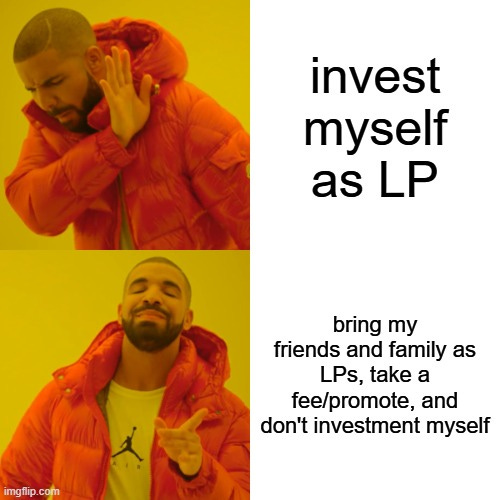
GP-driven feeder funds – more recently, GPs themselves have started pitching new LPs on becoming “mini-fund managers.” Instead of an investor choosing to set up a feeder fund on their own, GPs provide all the infrastructure for such an individual, and then the person will effectively become a fundraiser on behalf of the GP.
The end result of the latter looks a lot like the Northwestern Mutual model. A fairly new investor, with limited knowledge of the risks, suddenly becomes responsible for raising money from their closest friends and relatives.
The feeder manager doesn’t fully understand what they’re selling, and the friends and family invest mostly out of trust. This is quite close to the blind leading the blind.
2 - Fractional investor relations
At first glance, “fractional investor relations” sounds logical. After all, we already have fractional CFOs, CMOs, and other shared executive functions. But the LP experience here is different:
The perception problem: most LPs assume the IR person they’re speaking with is a full-time employee of the GP. In reality, many of these fractional IR professionals juggle 3-10 clients at once.
The knowledge gap: a full-time IR professional usually knows the GP, the portfolio, and the investment thesis inside and out. If they smell something is off, many will have the ethics to leave. Meanwhile, a fractional IR person will usually have a glimpse into a firm … but functionally their job is a lot more similar to an equity broker than an IR professional (even though the latter is in their signature!).
What’s interesting too, is that these two strategies come together. In some sense, the GP-driven feeder fund guy is a fractional IR person for the firm. What’s also worrisome is that in both cases the ultimate LP doesn’t fully understand who they’re dealing with:
**GP-driven feeder funds - **many times the LP doesn’t understand that he’s not speaking with the GP and that in some cases the GP will not even answer their calls (since the LP is an investor in the feeder, and the GP “officially” typically only has to respond to the manager of that fund rather their individual investors)
**Fractional investor relations - **the LP will often assume that the person they’re dealing with is employed full time by the GP.
By the way, there is a counterargument to be made that fractional IR people gain useful perspective by seeing multiple sponsors in action. I do think this has some truth, but it’s likely only true at the surface level.
I’m not here to police anyone, and admit that I could be wrong (look forward to your feedback by the way!) … but both of these trends introduce new layers of risk and opacity that LPs should be aware of in my opinion. Just like with Northwestern Mutual internships, the surface can look polished - but what matters is whether the person on the other end truly understands what they’re selling, and whether you fully understand what you’re buying.
When you’re ready, I could help you in 3 ways - simply reply to this email if one is of interest:
Limited Partners:
***GP-LP Match - ***a simple way for you to get more deal-flow that matches your precise LP parameters. You can join here in under a minute.
Potential positions - you’re considering investing and need an independent opinion
Existing positions - there’s a lack of communication, you’re concerned about fraud, or perhaps you got a capital call request and you’re not sure how to proceed. I have also helped LPs with a “post-mortem” analysis on deals that didn’t work out - it’s important to learn these lessons as opposed to just blaming the GP.
LP Course - review 4 separate memos in 4 weeks together with me and other LPs to learn how to find good LP investments.
LP Topics Seminar** - **an ongoing biweekly 1 hour meeting with other LPs where we'll go over investment decks, capital calls, distressed situations, and modeling. This is meant to provide a deeper look into existing LP investments. Please reply to this email if you’re interested.
***LP Community - ***free 2,800+ member LP Investor community on Twitter
***Find GPs ***in unique asset classes/geographies on my monthly intro post (see LinkedIn’s post as well for more)
General Partners:
Deck review - I’ll look over your marketing materials from the perspective of an LP and provide slide by slide commentary to improve your pitch
Investment review - I’ll provide independent feedback on an opportunity you’re pursuing
Capital call advisory** - **you suspect that you’ll need to make a capital call, but aren’t sure how to proceed or communicate the message.
Other - anything from waterfall/fee advisory to disagreements between co-GPs on the proper path given a set of circumstances
General Consulting: modeling, strategic advisory, underwriting training, etc.
If you’d like to speak on the phone, you can reach me at aleksey@centriocapital.com.