Aleksey Chernobelskiy
•July 11, 2024
We renovated, but will they come?
On multifamily value add strategies and renovations that don't make sense
**Last premium post: **6 Lessons on the Perils of Quick Advice
Last free post: LP Investing Digest #37 & Full Article Index By Topic
**Podcast Guests: **if you have lessons to share anonymously after a successful or an unsuccessful LP investment, please respond to this email. Previous podcast episodes are here.
If you just joined: I write 2x / week and you’ll receive those emails as I post them. One article is premium (such as this one), while the other is a free digest of LP topics that might be helpful to you. If you’d like to upgrade to premium (which includes access to the full archive of 70+ articles), you can do so below.
You can always reach me at aleksey@hey.com & follow my free posts on LinkedIn & Twitter/X.
We renovated, but will they come?
Welcome back!
I’m sure you’ve heard of the phrase “build it and they’ll come.”
This week’s article and topic is a play on that, because sometimes renovations don’t make mathematical sense even though they sound very luxurious. 😊
In today’s post I’ll spend some time establishing why renovations can be so lucrative, and then point to counterexamples where this logic falls apart using a datatable.
If you’re an LP, this article will explain one of the most critical components of multifamily investments - renovations, or otherwise generally referred to as value add strategies. We will also learn more about what to look out for to make sure you know how to ask the right questions.
If you’re a GP, I hope this article will resonate with how you think about whether future renovation make sense. There are circumstances where (even if you promised renovations to LPs) they no longer make sense, and it’s in the best interests of both parties to not proceed.
Let’s dive in:
Investing in Multifamily Properties: When Does Renovation Make Sense?
When considering an investment in a multifamily property, one of the key decisions is whether to renovate the apartments.
As we’ll walk through in the below analysis, renovations can significantly increase the property's value (by increasing net operating income, “NOI”).
Here’s a step-by-step guide to help you (whether you’re an LP or GP!) determine if renovating makes financial sense:
Estimate Renovation Costs
Calculate the total cost of the renovations. This includes materials, labor, permits, and any other expenses.
Typically this figure will be provided by the GP - if it’s not, I would ask for it
The scope of the renovation vs the estimated cost is something to look out for - it’s hard to know whether the estimate is precise, but you’ll know if it’s WAY off (and those are the situations you really need to catch as an LP)
Calculate Potential Rental Increase
Determine the additional rental income you can expect after renovations.
Again, this is typically provided to you by the GP using comparable properties in the area that have similar sized apartments that have been renovated.
A few things to look out for:
One of the best comps is the property itself! If there have been any recently renovated units that were leased, you should ask for details ($ rent, when the lease was signed, and length)
When looking at comparable apartments at nearby properties to determine the rent premium on renovated units, keep vintage (year built), amenities, and other factors (e.g. nicer area, gated community, pool, etc) in mind that might make the other rent higher than you’d be able to achieve at the property you’re considering investing in
Determine the Increase in NOI
Calculate the increase in NOI by considering the additional rental income and any changes in operating expenses.
For the sake of simplicity, in our example below we’ll assume that the renovated apartment revenue falls directly to the bottom line (NOI).
In other words, you don’t expect any additional expenses by renovating. There are exceptions to this, of course.. so you need to ask what the plans are, here are some examples:
If you built a pool and there was no pool before, you’ll have additional costs within NOI now for maintenance
If you’re putting in water filters or cable internet, there will be maintenance costs that you previously didn’t have
I hope these examples help with context.. of course there are many more
Assess the Impact on Property Value
Use the capitalization rate (cap rate) to estimate the increase in property value based on the increased NOI.
This is where the “magic” happens, as we’ll see in the below example… every dollar in NOI has a large impact on property value, since it’s valued based on a cap rate (or a multiple of earnings, is another way to think about it)
Example Renovation Decision
For the sake of simplicity, let's consider a 10-unit apartment building.
**
Current Situation:**
Current rent per unit: $1,000/month
Total current rental income: 10 units * $1,000 = $10,000/month
Annual rental income: $10,000 * 12 = $120,000
Operating expenses: $60,000/year
Current NOI: $120,000 - $60,000 = $60,000/year
Renovation Proposal:
Estimated renovation cost per unit: $10,000
Total renovation cost: 10 units * $10,000 = $100,000
Expected rent increase per unit: $200/month
New rent per unit after renovation: $1,200/month
Total new rental income: 10 units * $1,200 = $12,000/month
Annual new rental income: $12,000 * 12 = $144,000
New NOI: $144,000 - $60,000 (same expense load as before, see my caveat above on this assumption) = $84,000/year
Increase in NOI: $84,000 - $60,000 = $24,000/year
Impact on Property Value:
Assuming a cap rate of 5%
Increase in property value = Increase in NOI / Cap rate
Increase in property value = $24,000 / 0.05 = $480,000
With a $100,000 investment in renovations, the property value increases by $480,000 due to the higher NOI, providing a substantial return on investment.
Now I want to pause for a second to explain how we implicitly made three assumptions here:
Rent premium ($200/month/unit above)
Cap rate (5%)
Cost ($10,000/unit)
When Renovations Might Be a Mistake
To explain further, see the table below and find the blue $480,000 (same number as above in bold, which assumes a $200 monthly rent premium as a result of the $100,000 renovation with an exit cap rate of 5%).
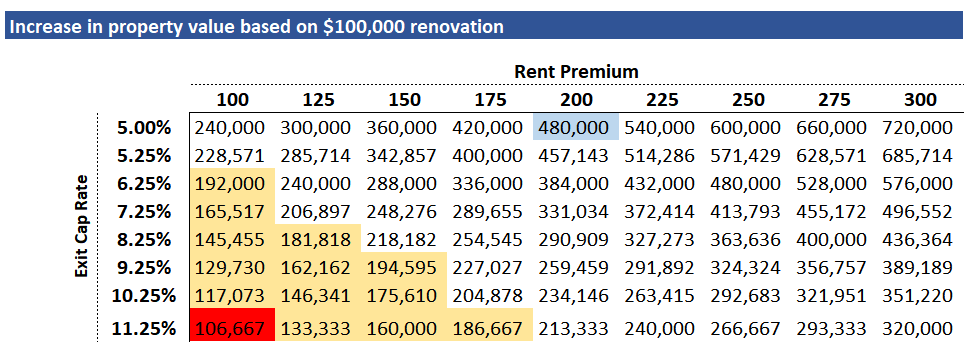
You can see how if the exit cap rate goes up, the renovations naturally mean less from a return perspective.. holding the $200 premium constant, you’ll see that the increase in property value drops as you go down that column
If both the rent premium drops and the exit cap rate assumption was wrong, you could end up in the red. Here there’s only one cell (in red) that’s close to the $100,000 renovation cost, but remember that we’re completely ignoring many costs (it costs money to sell a property, an apartment needs to be vacant for some time to renovate it, etc)
Now what happens if the $10,000/unit assumption was wrong and doubles to $20,000? You can see how using the same assumptions, you’ll be in the red in all yellow scenarios
In simple English: you spent $200,000 on something and created less than $200,000 in value!
This is why questioning these three assumptions is really important as an LP
Another way to think about renovation value:
Payback period - how long it’ll take you to recoup your money (assuming you kept the building):
[Cost of Renovation]/[Annual NOI Marginal Premium]
Obviously if you can get your money back quickly, that’s good!
Return on invested cash - how much the improvements are expected to earn you against other alternatives (again, assuming you kept the building):
[Annual NOI Marginal Premium]/[Cost of Renovation]
e.g. if the expected percentage is 5% per annum, a GP could distribute the cash to their LPs and they can make that return risk free (ignoring taxes for a minute) as opposed to risking it in the renovation process
It’s important to note that you (as an owner or investor) would benefit from both the cap rate and payback/return approaches, in a sense.
In other words our analysis really focuses on the second of the following (increased value upon sale) to illustrate a simpler approach to making a decision since the first one is typically short in nature:
Once you renovate a unit you immediately get benefit from the rent premium
When you sell, you’ll also get a higher valuation based on the increased NOI
As always, would love to hear any questions or comments and wishing you a wonderful weekend ahead.
I advise LPs on existing and potential positions and write articles here weekly on what I see in the marketplace that could help you invest better. You can find me on LinkedIn or Twitter.
Whether you’re an LP, want to learn to become one, or affiliated with LPs (GPs, Attorneys, CPAs, Financial Advisors) I hope you’ll consider subscribing and sharing this post to help others make more informed investment decisions.
When you’re ready, I could help you in 3 ways - simply reply to this email if one is of interest:
Limited Partners:
Potential positions - you’re considering investing and need an independent opinion
Existing positions - there’s a lack of communication, you’re concerned about fraud, or perhaps you got a capital call request and you’re not sure how to proceed. I have also helped LPs with a “post-mortem” analysis on deals that didn’t work out - it’s important to learn these lessons as opposed to just blaming the GP.
LP Course - review 4 separate memos together with me and other LPs to learn how to find good LP investments.
***LP Community - ***free 2,200+ member LP Investor community on Twitter
***Find GPs ***in unique asset classes/geographies on my monthly intro post (see LinkedIn’s post as well for more)
General Partners:
Deck review - I’ll look over your marketing materials from the perspective of an LP and provide slide by slide commentary to improve your pitch
Investment review - I’ll provide independent feedback on an opportunity you’re pursuing
Capital call advisory** - **you suspect that you’ll need to make a capital call, but aren’t sure how to proceed or communicate the message.
Other - anything from waterfall/fee advisory to disagreements between co-GPs on the proper path given a set of circumstances
General Consulting: modeling, strategic advisory, underwriting training, etc.
If you’d like to speak on the phone, you can reach me at aleksey@hey.com.
Join GP-LP Match
Sign up, then tell Sloan, our concierge, what you invest in. Sloan brings you sponsors whose raises fit, and your identity stays private until you say yes.
Message SloanNo cut of the capital you deploy.