Aleksey Chernobelskiy
•April 3, 2024
Guaranteed red flag
Why "guaranteed" typically means the opposite
Last premium post: The Refinance Assumption Trap
Last free post: LP Investing Digest #23 & Full Article Digest
If you just joined: I write twice per week and you’ll receive those emails as I post them. One article is always premium (such as this one), while the other is a free weekly digest on LP topics that might be helpful to you. If you’d like to upgrade to premium (which includes access to full archive of my articles), you can do so here:
Guaranteed red flag
Welcome back! 👋
It’s not uncommon to see investment opportunities use the word “guaranteed.”
Sometimes, the word is used over a phone conversation but other times it is put directly into the marketing package that is shown to limited partners. I had strong opinions on the matter when I first saw this, but thought it was rare in the industry and didn’t feel that it needed to be addressed.

It is being used by fairly large syndicators (who should certainly know better) and
Some LPs don’t realize why the term is deceptive and invest thinking the GP is being honest
Today, I would like to address the issue and explain through several examples/screenshots why it is such a problem to present the deal in this manner (and an even larger problem to invest in a deal based on this assumption).
Let’s dive in:
I recently wrote in The Refinance Assumption Trap the fact that I try to stay away from guiding to “red flags,” because they tend to oversimplify a process that should be inherently complex.
Here’s that piece from the article:
I am often asked what assumptions LPs should look out for when looking at a deal. I am very hesitant to give specific guidance on these matters, because what tends to happen is that LPs will check whether those 1-3 “red flags” are present … and then invest on them not being in the deal.
I think this strategy (if you can call it that?) is deeply shortsighted, because all investments need to be looked at through the perspective of balancing the pros and cons of the transaction. The closest I’ve gone to giving such guidance so far is writing the Top 15 Syndication Mistakes article, and mentioning on several podcasts that many of the deals that are having challenges today assumed some degree of cap rate compression at the time of investment.
Today, after some hesitation, I decided to publish the first “official” red flag that I’m comfortable stating publicly - any mention of the word “guaranteed” in conversations or marketing materials.
Let me explain why I feel so strongly about this, using some examples.
The screenshot below comes from one of the largest syndicators, they’ve raised hundreds of millions in equity to date .. and are actively raising more capital today (this deal being one example).

I initially thought that perhaps they only used that word in the PDF name, but once you open the file you find to the following:

So, what’s wrong with this?
If I told you that (1) the US government will guarantee a payment to you on the treasuries you bought or (2) your deposit in a bank (up to $250k) is guaranteed by the FDIC … everyone would agree that this is fine, right? We have certainly seen issues with similar structures outside of the US, but we all view the probability of a default to be so low that it’s “close enough” to guaranteed.
Similarly, all guarantees are a function of (1) likelihood of payment and (2) recourse. The first has a lot to do with the recourse and the investment, while the latter has more to do with what you’d be going after in court if you weren’t paid for whatever reason.
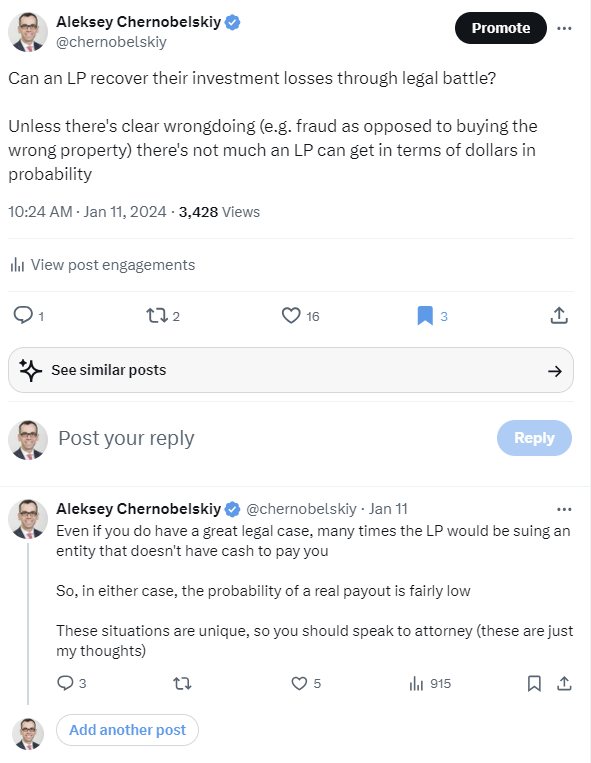
Here’s a relevant tweet of mine on the second point below:
So, let’s get practical. You ask a GP “hey what do you mean by guaranteed.. I heard from Aleksey that it isn’t?” Then the GP answers:
“You’re right, but this a super safe investment, we can’t lose money! So it’s basically guaranteed!”
In a weird way, the same sponsor that this article is about had a deal go sideways recently that literally (looking at the old deck as I type this) said that the deal “is about not losing money” … nearly all LP equity capital will be lost
Also see 4 below
“Did you look at the cash flows? They’re there, so it’s guaranteed!”
First, I’d make sure the proforma make sense.. they always have assumptions
If it does check out, great! But cash flows change based on a number of reasons (e.g. rents dropping, expenses rising, or debt costs rising).. i.e. not guaranteed
“I am personally guaranteeing this, so the cash flow is guaranteed”
This is an interesting one, because the investment recourse now has a new variable (the liquidity and net worth of the individual that’s PGing the investment, rather than the investment’s equity itself)
Although a PG does help de-risk an investment, I think this de-risking has a lot more to do with alignment rather than monetary benefits… here are a few reasons why:
Are you going to do full diligence on the personal financial statements behind the PG? Probably not (certainly not as an LP)… and even if you did, it would be hard to dig deep enough to understand the true benefit to you from a monetary standpoint
Even if you entered into an investment with a very strong PG, the PG might lose its value over the course of the investment
Even if the PG is strong, you might not be able to sue or an attorney would tell you the chances of you winning are low (see my tweet above)
“You’re taking this out of context, this is simply marketing! Obviously I didn’t mean that it’s literally guaranteed; I just mean that it’s safe and a great investment”
What they mean is the cash flows are in place, or perhaps even the fact that they’re likely.. but calling them guaranteed should give you enough of a reason to look the other way. Why though?
It could be that this is “simply marketing” and I’m overexaggerating, but remember that this is a relationship business that is predicated on trust with very little to no say once you’re invested as an LP.
As such, I think a natural next step after hearing the above would be “what else in this pitch is simply marketing?”
“We are reserving a part of the raise and the payments are coming from there… so the cash flow IS guaranteed!”
In the case of our example today, this was actually the case - here’s the screenshot from the sponsor’s presentation
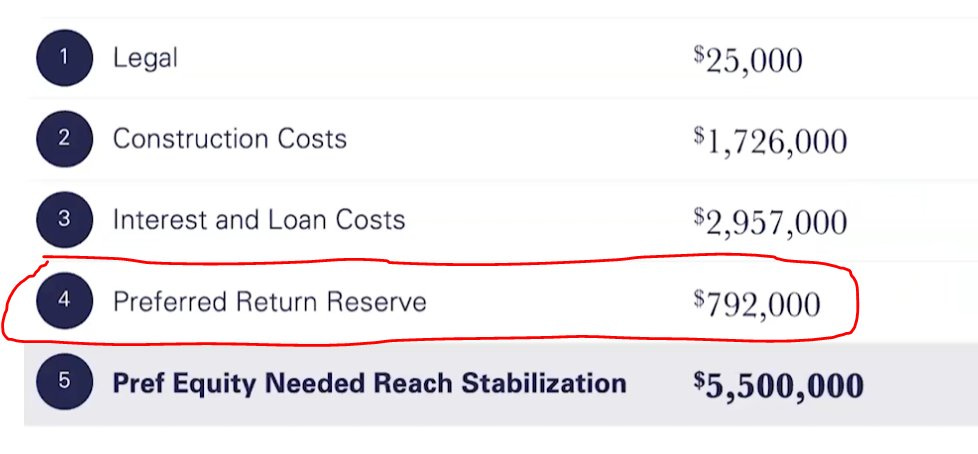
This opens up an entirely different can of worms, because what this basically means is that they’re saying you’re guaranteed to be paid a return from - you guessed it - YOUR OWN MONEY!
In other words, the word “guaranteed” here says nothing about the stability of the investment .. even though it’s being marketed all over to persuade you into investing
In fact it might suggest the opposite, since it indirectly implies that there isn’t enough cash flow to pay the payments from the property today
You are basically overfunding the deal to pay yourself.. and then the (obvious) question is whether the reserve will be enough to carry to the earlier of (1) getting taken out of your investment and (2) the underlying property being able to service the additional interest payments once the reserve runs out
An interesting side point here is what would happen if the project runs out of cash at some point and needs capital… and the reserve capital is still available.
Will the preferred equity capital (which is this investment) decide to pause the “guaranteed” payments, or perhaps decide to get even more expensive financing elsewhere?
The same question would apply in the event that the pref wants to take over the building (i.e. yank it from the GPs and operate it) .. as an LP you’ll get a notice saying that they had to stop the “guaranteed” payments because they decide to take over the building and now they need the capital for operations…
So, in summary, if you see the word "guaranteed" in a pitch, it’s fairly safe that you should run the other way. The same is true about other extreme statements about performance, such as “never lose money” below from a totally different deal.

So what words should be used instead? The below are all fine… but guaranteed is not fine in the context of the vast majority of syndications.
Predictable
Likely
Conservative
Low risk
Promising
Attractive
Safe (not great…but still much better)
Thank you for reading my rant! I hope you learned something and here’s one last meme. 😊

I advise LPs on existing and potential positions and write articles here weekly on what I see in the marketplace that could help you invest better. You can find me on LinkedIn or Twitter.
Whether you’re an LP, want to learn to become one, or affiliated with LPs (GPs, Attorneys, CPAs, Financial Advisors) I hope you’ll consider subscribing and sharing this post to help others make more informed investment decisions.
When you’re ready, I could help you in 3 ways - simply reply to this email if one is of interest:
Limited Partners:
Potential positions - you’re considering investing and need an independent opinion
Existing positions - there’s a lack of communication, you’re concerned about fraud, or perhaps you got a capital call request and you’re not sure how to proceed. I have also helped LPs with a “post-mortem” analysis on deals that didn’t work out - it’s important to learn these lessons as opposed to just blaming the GP.
LP Course - review 4 separate memos together with me and other LPs to learn how to find good LP investments.
***LP Community - ***free 1,900+ member LP Investor community on Twitter
***Find GPs ***in unique asset classes/geographies on my monthly intro post (see LinkedIn’s post as well for more)
General Partners:
Deck review - I’ll look over your marketing materials from the perspective of an LP and provide slide by slide commentary to improve your pitch
Investment review - I’ll provide independent feedback on an opportunity you’re pursuing
Capital call advisory** - **you suspect that you’ll need to make a capital call, but aren’t sure how to proceed or communicate the message.
Other - anything from waterfall/fee advisory to disagreements between co-GPs on the proper path given a set of circumstances
General Consulting: modeling, strategic advisory, underwriting training, etc.
If you’d like to speak on the phone, you can set up an initial consultation.
Join GP-LP Match
Sign up, then tell Sloan, our concierge, what you invest in. Sloan brings you sponsors whose raises fit, and your identity stays private until you say yes.
Message SloanNo cut of the capital you deploy.