Aleksey Chernobelskiy
•September 10, 2023
First LP Investment Pillar: Execution
Track record and counterparty risk
Happy Sunday!
On Friday, I finished the first of four sessions for my LP Course Cohort. Each participant took a deck, analyzed it throughout the week, and then we got together to discuss our findings.
Naturally, many questions surrounded evaluating a deal from an LP perspective and I’d like to break such an evaluation down into 3 critical pillars today.
The 3 real estate deal pillars as an LP:
It’s important to note that no investment is perfect and all deals will involve a substantial amount of risk. If you think you’re getting a safe return with a property that’s offering you an annual 15% return, there’s a good chance that you’re missing something…keep looking!
While each of the three pillars above (Execution, Alignment, and Property) are critical to an investment, they can (and should) be analyzed independently at the outset. This is because missing any one of them could be detrimental.
How so? Here are three examples:
Strong Execution: A sponsor could have great execution skills, but the sponsor missed a major risk on a property and thereby lost LPs money.
**Strong Alignment: **A GP has a favorable fee and waterfall structure, and perhaps even bought a great property with a realistic business plan. However, the investment failed due to lack of experience.
**Strong Property: **The GP is buying a phenomenal property, at a great price, and the business plan is realistic. However, the business plan didn’t go according to plan and as a result of a weak alignment of incentives (or lack of experience) the project failed.
I provided these examples to illustrate a critical point:
Investments are inherently risky and complex. No investment will rank 10/10 on each of the three pillars (if it does, do more homework). The best investments will have risks that you get comfortable with due to their respective mitigants.
With that introduction behind us, let’s dig into our first of three pillars:
Execution - track record and counterparty risk
The reason why execution is the first of the three pillars is because you’re about to get into a relationship, and a relationship is inherently trust based.
As a general rule, an LP will have little to no say about what happens with their investment from the day they sign the check.
This is important to think about, since once you invest in a syndication there will not be any opportunities to change your mind or influence the GP’s decision making (no matter how much you might disagree with them).
TRACK RECORD
Trust, but verify
This is a test of how long a GP has been in business and how well they did during that period.
All else equal:
A longer track record (through at least one economic cycle - not COVID) is better
Of course, higher returns that are consistent through cycles are better as well
Before we dig deeper on track record slides, a few disclaimers:
Although track records aren’t everything, it’s arguably one of the most important variables in understanding a deal.
Note that everyone has to start somewhere - every successful GP did their first deal at some point and didn’t have a 30 year track record!
This is fine, and you should be comfortable backing a new GP - just know that, all else equal, the risk is higher than a GP with a much longer track record.
For what it’s worth, some might say that the “eagerness” to succeed as an newer GP is hard to beat and, as a result, these GPs outperform the GPs with a long track record. In my opinion, if you take this experiment out to a sizable sample size, the opposite would be true - but of course there are counterexamples and phenomenal newer GPs!
All else equal, if a GP is new/newer, you should not take the same terms as a GP that has been in the business for a long time - this is because you have to compensate for the additional execution risk
Most GPs will have a track record slide. A few things to lookout for:
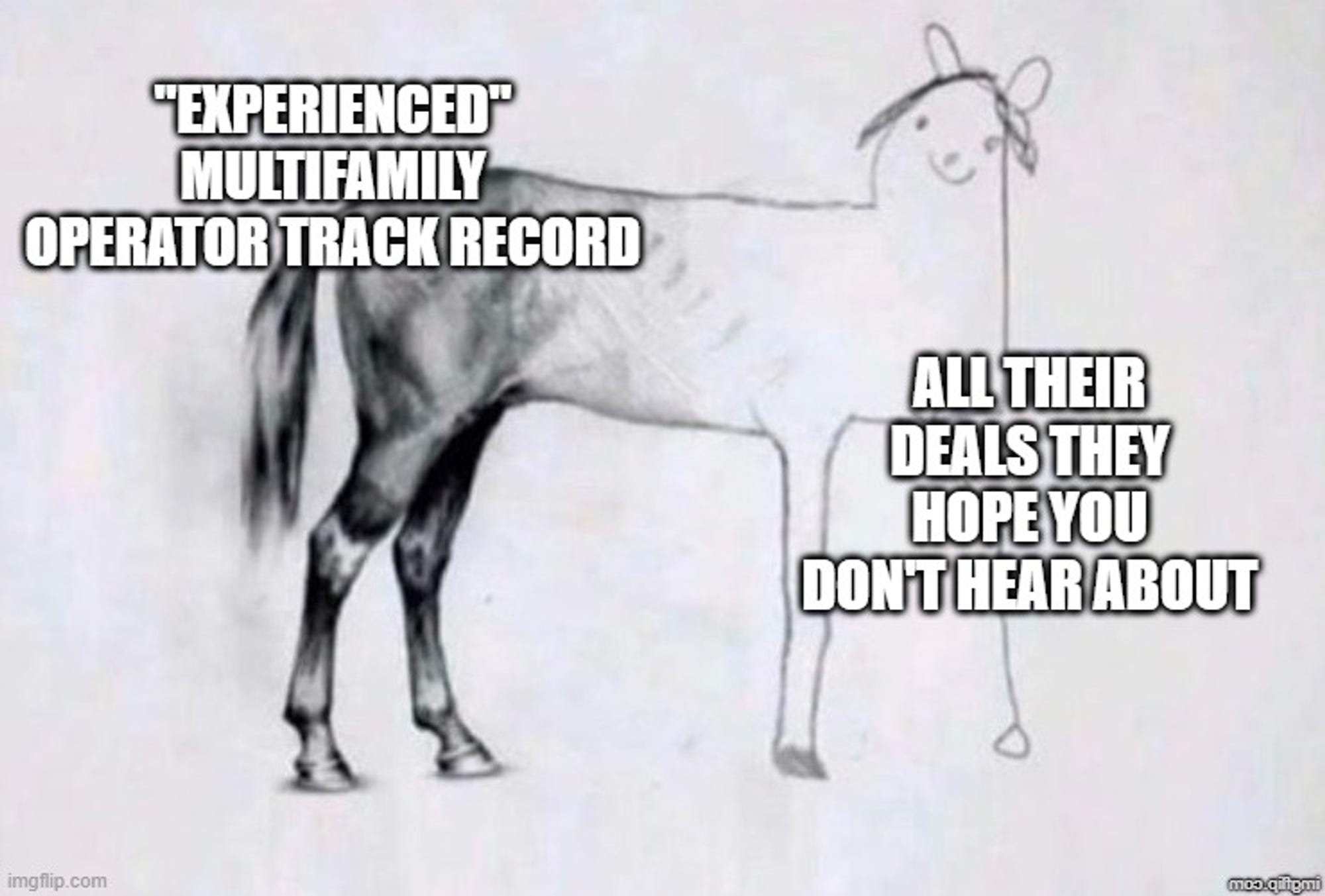
If the slide is vague or not specific to their experience (vs the experience of their corporate employer, for example), this is something you should notice immediately and ask about
The contents of the slide should specify properties that have been bought and sold by the GP (full cycle transactions), their entry and exit prices, returns, as well as entry/exit dates
Dates are particularly important - since not all exits are created equal. For example, if I bought a property in 2007 and sold in 2009 (right after the crash) and made a 2x multiple on equity, that’s a lot more impressive than buying in 2019 and selling in 2021 (when cap rates got lower as a result of cheap borrowing costs)
While we’re on this topic, I just want to mention that it’s important to separate skill from luck. Of course both are at play for any given GP, but entry/exit dates are one of the best ways to decipher this when you consider what was happening in the broader economy. I’ll write more on this another week.
Don’t just trust the track record… verify, and make sure it’s complete! I’ve seen cases where the track record slide was missing failed investments or the returns weren’t honestly presented
COUNTERPARTY RISK
First impressions matter
Since this a trust based relationship, you should ensure that the GPs and any relevant entities aren’t involved in material lawsuits
Note that lawsuits happen, and are part of business. The nature of the lawsuit is a lot more important than having a lawsuit itself.
In fact, sometimes an outstanding lawsuit might mean that the GP is savvy and is doing the right thing for the LP investors!
Although you can’t (and shouldn’t) purely base an investment decision on past lawsuits and disputes, it’s certainly something you should consider strongly as part of a larger investment decision.
There are GPs with stellar records that might do something ethically immoral, but the chances of someone doing something ethically immoral after a history of doing such things is likely higher when you consider a large enough sample size
If the GPs team seems a bit all over the place, that might be because it is…
I don’t have statistical proof for this, but I’ve seen numerous cases of deals falling apart where the GP entity is a compilation of people who work at different firms. There always has to be a clear decisionmaker, and that person needs to have experience in the field with the type of business plan that’s involved on the subject investment.
Check the GPs website and LinkedIn to see the backgrounds of the executive team .. do they seem fit for their titles based on their experiences?
Note that key man risk is important to think about here as well. What happens if something happens (unfortunately) to the GP him/herself and they’re no longer able to be a part of the business? Are there competent people in the firm to step up to the plate and be good (or at least “good enough”) stewards of capital until exit?
I hope this was helpful - wishing you all a wonderful week.
Next week, we’ll move to Alignment!
Whenever you’re ready, I could help you in 3 ways:
Limited Partners:
Future positions - you’re considering investing and need an independent opinion
Existing positions - there’s a lack of communication, you’re concerned about fraud, or perhaps you got a capital call request and not sure how to proceed
LP Course - if you’re interested in reviewing investment memos to get practice vetting deals, you can reach out by replying to this email.
General Partners:
Deck review - I’ll look over your marketing materials from the perspective of an LP and provide feedback to streamline and professionalize your process
Investment review - I’ll provide independent feedback on an opportunity you’re pursuing
**General Consulting **- modeling, strategic advisory, underwriting training, and much more.
Join GP-LP Match
Sign up, then tell Sloan, our concierge, what you invest in. Sloan brings you sponsors whose raises fit, and your identity stays private until you say yes.
Message SloanNo cut of the capital you deploy.