Aleksey Chernobelskiy
•May 2, 2024
Spotting GP/LP misalignment
7 examples of what happens when interests are misaligned
**Last premium post: **LP Investing Lessons Podcast #1
Last free post: LP Investing Digest #27 & Full Article Digest
Announcements:
May LP Cohort - 1 spot left. Review 4 separate memos together with me and other LPs to learn how to vet LP investments. If you’re interested, please reply to this email.
If you just joined: I write twice per week and you’ll receive those emails as I post them. One article is always premium (such as this one), while the other is a free weekly digest on LP topics that might be helpful to you. If you’d like to upgrade to premium (which includes access to full archive of my articles), you can do so here:
Spotting GP/LP Misalignment
Welcome back! 👋
I think everyone understands why it’s important to have alignment of interests in a healthy GP/LP relationship (see my second pillar of LP investing for background).
I have alluded to this topic for some time now, but now feel the need to write about it publicly as it’s quickly becoming a blind spot for LPs.

An important prelude to the conversation:
When alignment of interests goes awry, ethics of the GP comes into play.
A GP who’s bound by very strong ethical standards might not go through the same decision making process as another GP who’s purely motivated by their own net worth.
Having said that, the topic of discussion today is purely monetary (i.e. we’re putting ethics aside). My aim is to help you (LP) understand how the alignment of interests with your counterparty (GP) might diverge in certain circumstances. Understanding this will help you ask the right questions and hopefully the ethics of the GP only helps the situation once you understand the scope of any existing misalignment.
7 examples of what happens when interests are misaligned
GP/LP misalignment from day one
Let’s just understand and appreciate the fact that any GP entity (and the principals behind it) are running a business. The GP entity is one that is run (i.e. income) based off of fees and the promote on any given deal
From day one, the interests of the GP are to maximize the fees and the promote, while the interests of the LP are to maximize their own returns
You could see how this structure itself, in a sense, is one with conflicting interests … but that’s why I spend so much time thinking about alignment of interests (fees, coinvest, and waterfalls) before you start analyzing other parts of the deal (even the property itself)
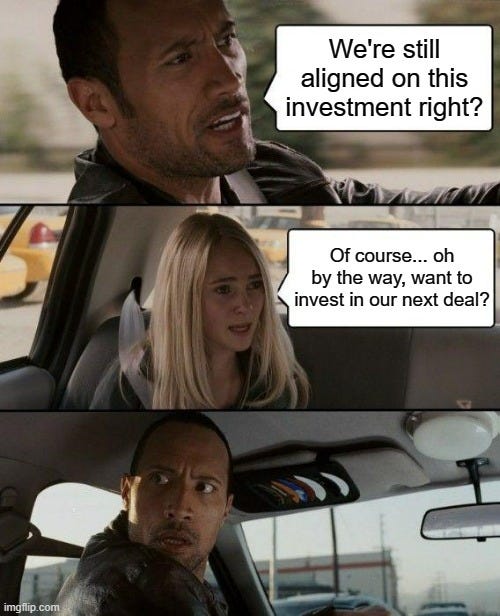
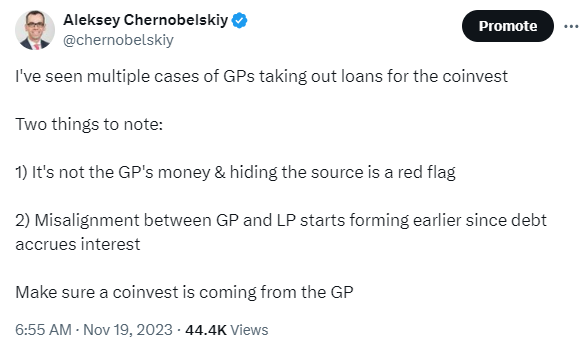
Some misalignment of interests start early as I described below - the source of the coinvest is important
It’s also important for the dollar amount to be material to the GP’s personal net worth (and don’t forget to differentiate between a coinvest contribution from the GP and one that’s put in from the acquisition fee - both help, but they’re not the same; see coinvest section here for more)
If the GP entity itself (i.e. the LLC that’s the GP behind the investments, even if some of the property level LLCs are healthy) isn’t doing well financially, this might lead to misalignments with the existing and future LPs as the GP is “in search” for cash
As an example, the GP might buy something a more risky investment just because they need a cash infusion in the form of an acquisition fee … this is obviously short sighted if it doesn’t work out, but it happens and the outcome of such an acquisition isn’t known for years
A GP might sell a property too early (from the perspective of maximizing LP returns) because they need the capital from the promote as well
Another version (less rare) could be buying something for the purpose of getting a management fee to sustain the existing infrastructure at the GP entity when other properties aren’t able to pay current management fees (i.e. the property level LLCs are accruing the fees, but are not able to afford paying them)
A given property’s promote is small relative to something else in the portfolio (or a new acquisition), so the GP’s attention slowly drifts away to the other investment
A more extreme version of #4 is a GP realizing that their promote (and in some cases management fees) are gone in a property.
Said another way (1) if the GP decides to keep the property the LLC doesn’t have enough cash to pay the GP its fees and (2) if the GP decides to sell the property the proceeds would not get to the promote level of the waterfall (e.g. there is a loss on investment, or perhaps there’s only enough capital for pref and return of capital).
**This is extremely common today **and can (again, ethics aside) lead the GP to focus their attention elsewhere which is in direct conflict with the LPs interests in a deal that’s struggling.
This is why I’ve been a proponent of LPs understanding their positions and (strategically) reaching out to the GP to ensure things are moving along and there’s proper accountability (more on this topic in the LP section here)
Property can barely return enough money to investors if it were to be sold today
At such a juncture the GP has a decision to make: (1) sell and “record” the subpar transaction on their books/track record, or (2) let it ride in the hopes of improving the track record mark.
Many GPs choose #2, even though probabilistically speaking the decision that was best for LPs was to sell today. This requires capital which will be the topic of 6b below
This touches on capital call ethics, where a GP might push for a capital call even though it doesn’t make economic sense
Capital call communication to raise more money will say something like “you have a chance to save the property” which might, in some cases, be loosely be translated to “you (LP) have a chance to save our (GP) reputation” .. while the chance to save the property and the LP investment is more or less gone
Major misalignment here because LP wants to save as much money as possible while the GP is more incentivized by avoiding conflict, subpar track record results, lawsuits, and bad press… all of which have a chance of impairing their business model (which requires fundraising) as a GP
This is common as well, especially in the past ~2 years - always make sure you understand why a given decision (hold vs sell) makes sense
Misalignment between lender and GP
Up until now we talked about misalignment between GP and LP, but now we’ll turn to GP and the lender (or preferred equity partner for the sake of example)
In many circumstances I’ve seen GPs downplay their situations to an LP (see 6(b)(ii) above for the reason), saying that their counterparty is a partner and will “play ball” when it comes to modifications
I have certainly seen many modifications done, but it’s important to realize that the counterparty has their own investors to protect and at some point their fiduciary duty to those investors will “outweigh” any existing relationship with the GP
As an example, if a senior lender or pref provider is seeing impairment (or getting close to it) on their principal that was invested and doesn’t believe in the GPs ability to turn the situation around, they might enforce their contract to take the investment into their own hands (thereby wiping out common equity in most cases)
The opposite is also true - if a capital partner such as lender or preferred equity provider is deeply out of the money (i.e. would suffer a great loss on principal if the property was to be sold) they might have an incentive to roll the dice themselves (see 6b above - now simply applied to the investors behind the lender) in the hopes of an eventual recovery
What you’ll notice is that the misalignment occurs (mostly) on the edges - in very good outcomes or very bad outcomes.
With the very good outcomes (for example selling too early to recognize a promote) the LPs don’t mind too much.. they did well and in a short time, so it’s hard to complain here.
With the bad outcomes, LPs get really upset.. and sometimes even more upset when they find out that a disposition fee was taken out of proceeds of an already distressed sale.
I advise LPs on existing and potential positions and write articles here weekly on what I see in the marketplace that could help you invest better. You can find me on LinkedIn or Twitter.
Whether you’re an LP, want to learn to become one, or affiliated with LPs (GPs, Attorneys, CPAs, Financial Advisors) I hope you’ll consider subscribing and sharing this post to help others make more informed investment decisions.
When you’re ready, I could help you in 3 ways - simply reply to this email if one is of interest:
Limited Partners:
Potential positions - you’re considering investing and need an independent opinion
Existing positions - there’s a lack of communication, you’re concerned about fraud, or perhaps you got a capital call request and you’re not sure how to proceed. I have also helped LPs with a “post-mortem” analysis on deals that didn’t work out - it’s important to learn these lessons as opposed to just blaming the GP.
LP Course - review 4 separate memos together with me and other LPs to learn how to find good LP investments.
***LP Community - ***free 2,000+ member LP Investor community on Twitter
***Find GPs ***in unique asset classes/geographies on my monthly intro post (see LinkedIn’s post as well for more)
General Partners:
Deck review - I’ll look over your marketing materials from the perspective of an LP and provide slide by slide commentary to improve your pitch
Investment review - I’ll provide independent feedback on an opportunity you’re pursuing
Capital call advisory** - **you suspect that you’ll need to make a capital call, but aren’t sure how to proceed or communicate the message.
Other - anything from waterfall/fee advisory to disagreements between co-GPs on the proper path given a set of circumstances
General Consulting: modeling, strategic advisory, underwriting training, etc.
If you’d like to speak on the phone, you can reach me at aleksey@hey.com.
Join GP-LP Match
Sign up, then tell Sloan, our concierge, what you invest in. Sloan brings you sponsors whose raises fit, and your identity stays private until you say yes.
Message SloanNo cut of the capital you deploy.