Aleksey Chernobelskiy
•September 20, 2024
Track record audit
How to catch problems in track record slides
**Last premium post: **LP Investing Lessons Podcast #8
Last free post: LP Investing Digest #47 & Full Article Index By Topic
Announcements:
**LP Cohort: **Review 4 deals with me and other LPs to learn what to look out for - please reply to this email if it’s of interest.
LP Topics: a more advanced ongoing biweekly 1 hour meeting with other LPs where we'll go over investment decks, capital call / distressed situations, and modeling. Please reply to this email if you’re interested.
Track Record Audit
Happy Thursday! 👋
Everyone agrees that a track record is important, and I agree - there’s a reason why I put it in the first pillar of LP investing. It might even surprise you that I think it’s more important (from the perspective of an LP) than analyzing the property itself, which is the third and last pillar.
Today I’ll discuss what I personally look for in track record slides, as well as give 3 examples of how a track record slide might not be as great as it appears.
If you’re an LP, this will teach you what to look for in an investment.
If you’re a GP, this will help you present yourself in the best way possible.
First, here’s an outline of what I look for in track record slides and why it matters:
Asset Class / Geography / Size Experience:
Has the GP worked with the specific asset class (e.g., multifamily, office, industrial) you’re investing in and were they of similar scale?
Similarly, has the GP invested in this submarket before? Do you they have current investments nearby?
A strong track record in one asset class & geography doesn’t necessarily translate to success in another.
Market Cycles:
Is the GP experienced in various economic cycles?
It's much easier to succeed in a bull market, but how has the GP performed in challenging conditions? More on this further below
The past few years haven’t been easy.. are there any deals that are struggling? Ask for reporting package example to see how transparent the GP is with their LPs on these challenges
Historical Returns:
Review the actual returns on past deals, not just projections… more on this further below.
Ensure the returns you’re looking at are to the LP, not deal level (there can be a big difference between the two depending on the split economics - see #2 here)
Team:
Does the GP have the right team and resources to manage large or complex deals?
A track record that hinges on a single person is riskier than one backed by a seasoned, multidisciplinary team - this is sometimes referred as key man (or woman :D) risk
Transparency:
If someone isn’t being transparent in the beginning, they likely won’t be transparent when/if challenges arise.
No answer (or an incomplete answer) is also an answer… you just might not like hearing that…
With that out of the way, let’s discuss some examples that I’ve seen many times.
Examples of Potentially Misleading Track Record Information:
Some track record information can be misleading if not properly questioned. Here are common examples of how the numbers you’re presented might not tell the full story:
Manipulated IRR Through Short Hold Periods:
Internal Rate of Return (IRR) can be inflated by a short hold period. For instance, a high IRR might look impressive, but if the asset was held for a month or two, the short time frame naturally boosts the IRR. Therefore, it may not reflect the GP’s long-term value creation abilities.
Needless to say, this works the other way as well - if something was held for a long time (due to a downturn in the middle) then making a lower IRR while doing the right thing for the LPs is likely a great indicator despite the IRR being lower due to hold period
Key Insight: Always ask for the acquisition and disposition dates. Look at both IRR and equity multiple to better understand the GP's long-term performance.
Dates are particularly important - since not all exits are created equal. For example, if I bought a property in 2007 and sold in 2009 (right after the crash) and made a 2x multiple on equity, that’s a lot more impressive than buying in 2019 and selling in 2021 (when cap rates got lower as a result of cheap borrowing costs)
While we’re on this topic, I just want to mention that it’s important to separate skill from luck. Of course both are at play for any given GP, but entry/exit dates are one of the best ways to decipher this when you consider what was happening in the broader economy.
Misleading Sale Price Due to Cap Rate Compression:
A property sold at a high price may seem like a win, but if the Net Operating Income (NOI) remained flat during the hold period, the increase in value might have been due to market-driven cap rate compression rather than the GP’s asset management.
In other words, the GP sort of got lucky on timing… and wasn’t able to execute on the value add strategy
Key Insight: To the extent possible (or available), look at both the entry and exit NOI to assess if value was truly created through the GP’s efforts, rather than macroeconomic factors.
Valuations Without Full Context:
GPs might present property valuations / exit price alongside the acquisition basis to show how much capital they expect to make for LPs, but these numbers can be misleading without the right context.
Valuations are often based on assumptions about the NOI and cap rates…and both of those could’ve changed substantially since they updated their projected exit projections/valuations. Additionally, the property’s debt situation may have changed since acquisition as well - e.g. a new piece of debt was taken out from an external party of LPs to fund a capital call, and it was not part of the original basis.
What are the NOI and cap rate assumptions of the exit/current value?
Was more debt added since the acquisition?
Are the cap rate assumptions recent and reflective of current market conditions?
Key Insight: Always ask for the assumptions behind the valuation and any changes to the debt structure to ensure the figures are realistic.
Including Deals Where They Weren’t the GP:
Some GPs may include deals in their track record where they weren’t the lead sponsor.
For example, they may have been an LP or a passive Co-GP who raised capital but didn’t manage the asset. While this experience is helpful, it’s not the same as being fully responsible for the success or failure of a deal.
I have also seen instances where GPs would include deals from a prior employer.. this is subject to some analysis, since larger companies typically have silos and you have to understand what this person was actually involved in (it was probably not everything) and how that translates to the investment you’re looking into
Key Insight: Ask for clarification on what role the GP played in each deal to ensure you’re evaluating the right level of responsibility.
Omitting Underperforming Deals or Errors in Underwriting:
GPs might highlight only their most successful deals and omit those that underperformed or where underwriting assumptions were incorrect. While we’re on this topic, I’ll also mention that I’ve seen instances of GPs changing their names (person or firm) in order to hide some of their past.
Key Insight: Request details on deals that didn’t meet expectations and ask how the GP adjusted their strategy after encountering challenges.
Time for a meme:
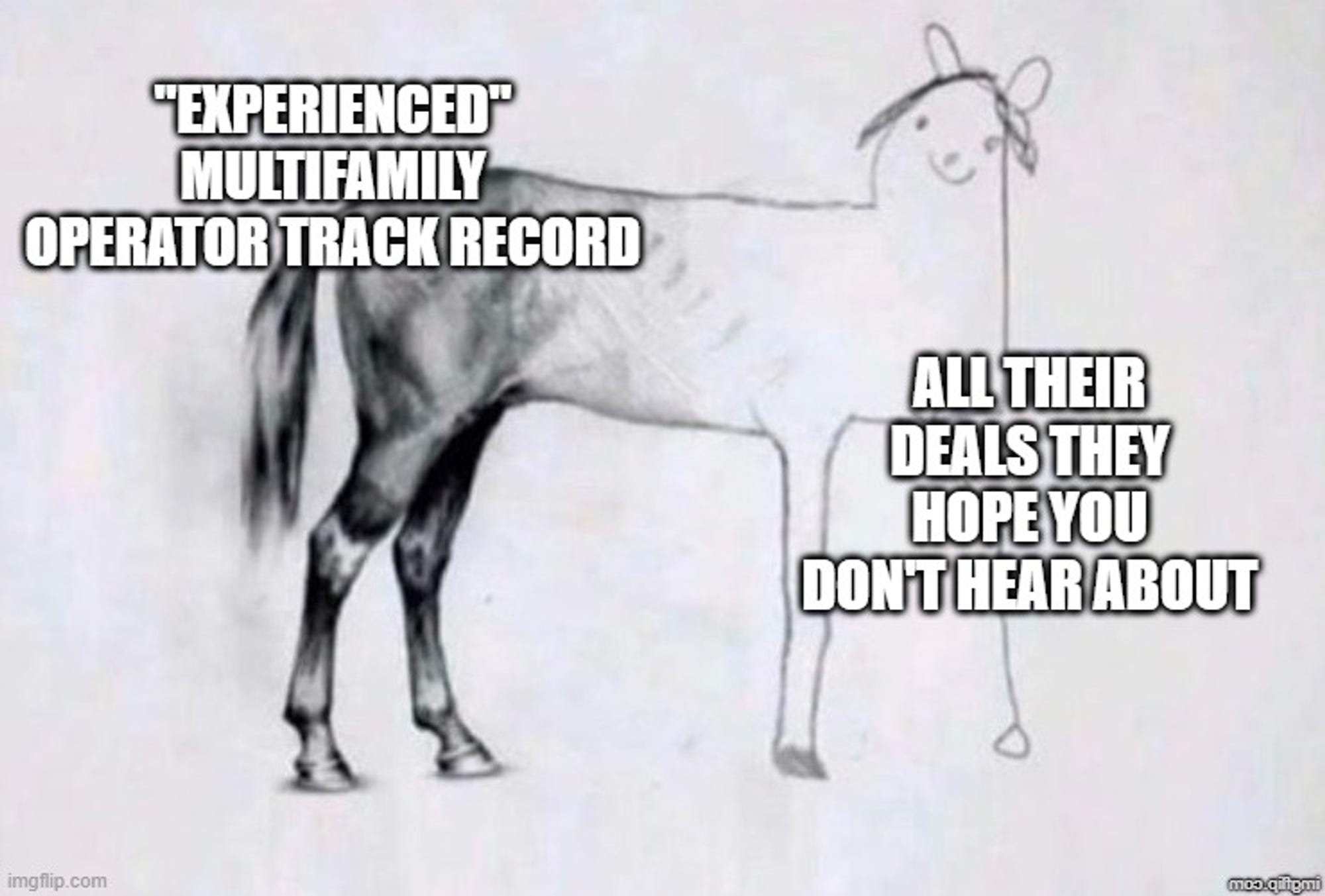
I’ll end with a quick reminder that just because a track record doesn’t exist, doesn’t mean you shouldn’t invest…
Note that everyone has to start somewhere - every successful GP did their first deal at some point and didn’t have a 30 year track record!
This is fine, and you should be comfortable backing a new GP - just know that, all else equal, the risk is higher than a GP with a much longer track record.
Some might say that the “eagerness” to succeed as an newer GP is hard to beat and, as a result, these GPs outperform the GPs with a long track record. In my opinion, if you take this experiment out to a sizable sample size, the opposite would be true - but of course there are counterexamples and phenomenal newer GPs.
All else equal, if a GP is new/newer, you should not take the same terms as a GP that has been in the business for a long time - this is because you have to compensate for the additional execution risk
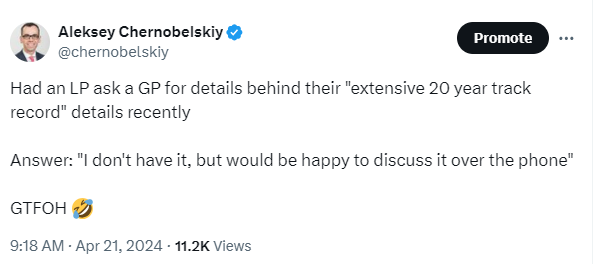
If you made it this far, you deserve a laugh! 😊
I advise LPs on existing and potential positions and write articles here weekly on what I see in the marketplace that could help you invest better. You can find me on LinkedIn or Twitter.
Whether you’re an LP, want to learn to become one, or affiliated with LPs (GPs, Attorneys, CPAs, Financial Advisors) I hope you’ll consider subscribing and sharing this post to help others make more informed investment decisions.
When you’re ready, I could help you in 3 ways - simply reply to this email if one is of interest:
Limited Partners:
Potential positions - you’re considering investing and need an independent opinion
Existing positions - there’s a lack of communication, you’re concerned about fraud, or perhaps you got a capital call request and you’re not sure how to proceed. I have also helped LPs with a “post-mortem” analysis on deals that didn’t work out - it’s important to learn these lessons as opposed to just blaming the GP.
LP Course - review 4 separate memos in 4 weeks together with me and other LPs to learn how to find good LP investments.
LP Topics Seminar** - **an ongoing biweekly 1 hour meeting with other LPs where we'll go over investment decks, capital calls, distressed situations, and modeling. This is meant to provide a deeper look into existing LP investments. Please reply to this email if you’re interested.
***LP Community - ***free 2,500+ member LP Investor community on Twitter
***Find GPs ***in unique asset classes/geographies on my monthly intro post (see LinkedIn’s post as well for more)
General Partners:
Deck review - I’ll look over your marketing materials from the perspective of an LP and provide slide by slide commentary to improve your pitch
Investment review - I’ll provide independent feedback on an opportunity you’re pursuing
Capital call advisory** - **you suspect that you’ll need to make a capital call, but aren’t sure how to proceed or communicate the message.
Other - anything from waterfall/fee advisory to disagreements between co-GPs on the proper path given a set of circumstances
General Consulting: modeling, strategic advisory, underwriting training, etc.
If you’d like to speak on the phone, you can reach me at aleksey@hey.com.
Join GP-LP Match
Sign up, then tell Sloan, our concierge, what you invest in. Sloan brings you sponsors whose raises fit, and your identity stays private until you say yes.
Message SloanNo cut of the capital you deploy.