Aleksey Chernobelskiy
•January 26, 2024
Is my investment distressed?
How to spot challenges before it's too late
*Welcome to the **137 *subscribers and 14 premium subscribers who joined since the last issue!
Last premium posts: Losing it all in foreclosure & 11 lessons from my NYC trip
Last free posts: LP Investing Digest #13 & Index of all 2023 LP articles
Announcements:
***LP Cohort ***- review 4 separate memos together with me and other LPs to learn how to vet LP investments. I have 1 more spot left in the February cohort and you can reply to this email if that’s of interest.
**Referral reminder: **if you’re on a budget, you can get up to 6 months for free of these articles by inviting 6 friends to this publication!
If you just joined: I write twice per week and you’ll receive those emails as I post them. One article is always premium (such as this one), while the other is a free weekly digest on LP topics that might be helpful to you. If you’d like to upgrade to premium (which includes access to full archive of my articles), you can do so here:
Is my investment distressed?
Welcome back!
This is part of a two weeks series based on what I’ve seen in the distressed world**: **
This week: Is my investment distressed?
That’s our topic for today - how to spot things before it’s too late
Once you know there is a challenge coming, what do you do? I’ll break this down for both GPs and LPs separately
We’ll cover 2 topics today:
Preface - applicable to both posts, please don’t skip this!
Spotting distress
**1) **Preface
As relayed in the tweet below, the situation behind the scenes is not simple and painful for many. Investing is difficult - sometimes people make mistakes, and in those circumstances such mistakes can cost people a chunk of their savings (and a lot of emotional/financial stress).
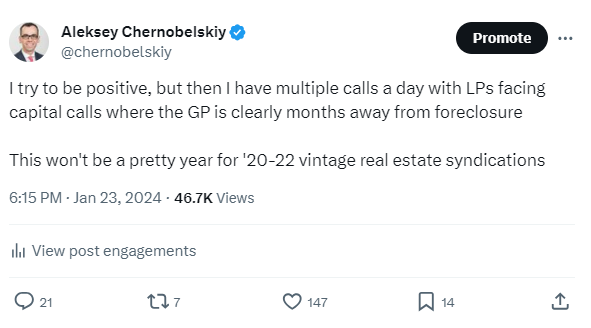
On that note, I just want to say that this is a painful subject for both GPs and LPs. GPs never planned to lose LPs money (let’s assume ethics were in place, they are in most cases), and many LPs invested thinking getting their principal back without a return was the worst case scenario (some didn’t even think that was possible).
It’s important to keep in mind that people are people and investments, regardless of outcome, are “just” investments. I say this because I’ve seen and know the other side of this (GP under pressure) and it’s unbelievably difficult. If you think your GP doesn’t care, they probably do. Having said that, distress tends to paralyze people because it’s so difficult to face the reality. This psychology applies to both GP and LP and is partially the reason for this post - if nobody does anything, the reality won’t go away!
Distress tends to paralyze people because it’s so difficult to face the reality.
Second, and as always, the contents of this article are simply my opinion. You should obviously feel free to do whatever you would like and there's no doubt that this article will miss certain angles or cases that require further analysis and thought. If you have something to add, please do!
Finally, notice how I didn’t jump straight into next week’s article on dealing with a distressed situation. That’s because it takes knowledge and analysis to arrive at the conclusion that an investment is in distress, so I’d like to start there today.
In other words, next week we’ll discuss how to deal with an issue, but how can you actually identify there IS an issue in the first place?!
Some might be thinking “eh, I’ll just wait… I don’t want to deal with this right now and maybe the problems will solve itself.” Or, perhaps, you’re an LP and think you can’t influence the outcome of your investment even if you realize it’s in distress.
In both cases, there’s (of course) a question of whether you’ll be able to do anything with the realization that a given property is in distress. Even a GP might not be able to do anything with the information, and they’re the ones in control! Having said that, having the information (and ideally having it early) is incredibly powerful for the GP and more powerful than most think even for the LP.
This week, I've seen a lot of GP capital call communication that was clearly rushed and not well thought out. The situations are very complex and therefore you need to plan and think in advance about the best options. An LP that can get in front of the situation will (worst case) be more prepared and (best case) be able to help the situation before it’s too late.
**2) **Spotting distress
Definition of distress can be super confusing. A common question I get from an LP is "I'm still getting a dividend so everything is fine... right?" Unfortunately, the answer is no.
A common question I get from an LP is "I'm still getting a dividend so everything is fine... right?" Unfortunately, the answer is no.
Generally speaking, property values are down (as a result of cap rates and debt costs rising), and in some cases they’re down very significantly. Many rate caps are expiring, NOI growth is no longer easy, and cash in refinances are common. We’ll touch on more of this in detail below.
As I hope you’ll learn from this article, your monthly dividend coming in doesn't mean that everything is fine. It's probably more "fine" (probabilistically speaking) than when the dividends aren't coming in, but I've also seen countless counterexamples here.
When most people think of distress, they think of a foreclosures, WSJ articles, or a deep economic recession. The reality, however, is that the stress on a given investment can occur during the best economic cycles and can go unnoticed until it's too late.
There are three primary ways to spot potential distress. Please note that there are counterexamples to each of these, but (1) these are meant to help you start the analysis and (2) hopefully through the analysis process you’ll ask the right questions and realize that everything is fine!
3 ways to spot distress:
Property value is less than (1) what you paid for it, or (2) its existing capital stack
First, grab the trailing twelve months Net Operating Income (NOI) from the latest reporting package and create a sensitivity table
One axis is the NOI and you can subtract some on one side of the axis, add some NOI on the other side of the current number. For an example of a sensitivity table see here.
Another axis is exit cap rate - i.e. what this could sell the property for today; it’s hard to pin point a number but a good “gut check” is starting with the cap rate this property was bought at … cap rates have moved up, and so it’s likely that the exit cap rate is higher than what you bought it at
Note that cap rates are a bit confusing, see here for more
If you’re really lost on where the cap rate could be, you could ask a broker or a GP (just keep in mind that the feedback might be biased, so adjust accordingly)
Then take a cell in that datatable, calculate NOI/Cap Rate and extend that cell across the table while locking the row/column values … this is the “range of outcomes” of possible valuations for your property
Note that during heavy renovations or construction, NOI might be severely lower than its “potential” since some of the units are not collecting rent - so watch out for that, but also be realistic… construction and leasing takes time, and perhaps you’ll run out of time (see more below on debt obligations)
Now that we’ve arrived at your estimated property value (or a range of them!), see how it compares to what you paid for the building.
If Property Value < Original Cost, there’s a chance that there are challenges and you should continue searching for more information
The next question is whether your existing equity is still “in the money” - i.e. is it worth the same, less, or more than when you invested the original principal
For the sake of simplicity, I’d recommend ignoring fees, closing costs, etc
In order to understand the equity’s position in the capital stack, ask yourself “if we were to sell the property today, what needs to be paid before I get paid”… this could include, in order of priority:
Senior Debt
Mezzanine Debt
Intercompany payables or other loans that might have priority to over equity
Preferred Equity
Then it’s equity… and perhaps there are different priorities of equity, so be on the lookout for that
Note that the capital structure of your property might have changed since acquisition - don’t just assume it’s the same as when you invested… some agreements allow GPs to raise debt/equity without formal consent (or notice) to LPs
If Deal Valuation < 1+2+3 above, there’s a chance that your equity (as it sits today) is completely wiped out
A quick note here… remember that your equity isn’t “totally wiped out” officially, until the property trades hands and you don’t get a penny. In other words, there has to be either a sale, or a foreclosure for this to occur “officially” but it’s also important to know what your principal is worth, roughly, today. This should help guide your decision making
Note that what we’ve calculated here is a “deal level” valuation, while the actual economics to GP/LP will vary based on the preferred return and split that you’ve agreed upon. Having said that, prefs and splits matter a LOT less when something is in the red… you’re simply trying to figure out if there’s still money to be made here. In other words, if you’re worried about how to split profits, your deal is probably NOT in distress (which isn’t the topic of this article)
NOI less Required Payments is close to 0 or negative
The most simple version of a “required payment” is the debt service on the mortgage.
This is pretty basic - if you run out of cash (as estimated by NOI - although there are differences between NOI and actual cash on hand … but that’s for another post as it’s too advanced for our current discussion) the lender won’t be happy and you could lose the building. This could even happen on a property where the equity is “in the money,” as we described above - putting it simply, if the lender doesn’t get paid they can either renegotiate the agreement with the owner or choose to take over the property through a legal proceeding.
Note that “required payments” might also include other payments such as payments to the mezzanine lender and/or preferred equity partner - in these circumstances, such third parties will likely want to take over ownership of the building to “step in” to the shoes of the existing GP in order to save their own invest position (and avoid getting foreclosed on by the senior lender/mortgage)
Finally, note that debt service is both principal and interest, and you might have had an interest only period that’s expiring (and the additional principal kicking in at a future date can cause challenge if there isn’t enough cash from the property cover it)
Maturities of debt, rate cap, or pref equity are coming
With the exception of cap rates which are market driven, you’ll notice that above we mostly talked about things that you could control, to some degree, though management - the NOI
The last, but arguably most common thread among distressed situation, is when an owner is forced to do something as it relates to obligations to third parties
For instance, if a preferred equity investment, a debt investment, or a rate cap matures, there are massive financial implications to the investment that need to be thought of far before these maturities.
In a debt maturity, you might need to do a cash IN refi - i.e. the incoming lender is lending you less than your existing debt balance on the property, and you therefore need to come up with cash to bridge the gap.
Pref maturities function similarly, for the purposes of this discussion
If a rate cap expires, you’ll be “forced” into paying the actual interest rate on your loan (which might be much higher than when you took out the loan)
This causes stress, since the NOI might not be able to cover this payment, and getting another rate cap is (1) expensive and (2) takes outside dollars to fund that are currently not already available in the property level LLC - unless, of course, you plan for this in advance!
Debt instruments are great tools to increase equity returns, but they always come at a risk… during good times these risks go unnoticed and written off as being risk free, while during challenging times people are reminded why the capital structure (and the respective maturities) of a investment are so important.
Thank you for reading! I genuinely hope you found this helpful - the best way to say thank you is to spread the word.
I have dozens of topics on my list for 2024 and I’m very excited. If you have a topic you’d like me to cover or have any questions on this article, please leave a comment.
I advise LPs on existing and potential positions and write articles here weekly on what I see in the marketplace that could help you invest better. You can find me on LinkedIn or Twitter.
Whether you’re an LP, want to learn to become one, or affiliated with LPs (GPs, Attorneys, CPAs, Financial Advisors) I hope you’ll consider subscribing and sharing this post to help others make more informed investment decisions.
When you’re ready, I could help you in 3 ways - simply reply to this email if one is of interest:
Limited Partners:
Potential positions - you’re considering investing and need an independent opinion
Existing positions - there’s a lack of communication, you’re concerned about fraud, or perhaps you got a capital call request and you’re not sure how to proceed. I have also helped LPs with a “post-mortem” analysis on deals that didn’t work out - it’s important to learn these lessons as opposed to just blaming the GP.
LP Course - review 4 separate memos together with me and other LPs to learn how to find good LP investments.
***LP Community - ***free 1,600+ member LP Investor community on Twitter
***Find GPs ***in unique asset classes/geographies on my monthly intro post (see LinkedIn’s post as well for more)
General Partners:
Deck review - I’ll look over your marketing materials from the perspective of an LP and provide slide by slide commentary to improve your pitch
Investment review - I’ll provide independent feedback on an opportunity you’re pursuing
Capital call advisory** - **you suspect that you’ll need to make a capital call, but aren’t sure how to proceed or communicate the message.
Other - anything from waterfall/fee advisory to disagreements between co-GPs on the proper path given a set of circumstances
General Consulting: modeling, strategic advisory, underwriting training, etc.
If you’d like to speak on the phone, you can set up an initial consultation.
Limited Partner (LP) Investing Lessons is a reader-supported publication. To receive new posts and support my work, consider becoming a free or paid subscriber.
Subscribed
Join GP-LP Match
Sign up, then tell Sloan, our concierge, what you invest in. Sloan brings you sponsors whose raises fit, and your identity stays private until you say yes.
Message SloanNo cut of the capital you deploy.