Aleksey Chernobelskiy
•July 31, 2024
Filtering using IRR and CoC is dangerous
The dangers of single metric filtering
**Last premium post: **Passive investments require active monitoring
Last free post: LP Investing Digest #40 & Full Article Index By Topic
If you just joined: I write 2x / week and you’ll receive those emails as I post them. One article is premium (such as this one), while the other is a free digest of LP topics that might be helpful to you. If you’d like to upgrade to premium (which includes access to the full archive of 70+ articles), you can do so below.
You can always reach me at aleksey@hey.com & follow my free posts on LinkedIn & Twitter/X.
Announcements:
**LP Topics Seminar: **an ongoing biweekly 1 hour meeting with other LPs where we'll go over investment decks, capital call and distressed situations, and modeling. This is meant to provide a deeper look into existing LP investments. Please reply to this email if you’re interested.
**Podcast Guests: **if you have lessons to share anonymously after a successful or an unsuccessful LP investment, please respond to this email. Previous podcast episodes are here.
Why focusing on IRR and CoC can harm you as an LP
Happy Wednesday! 👋
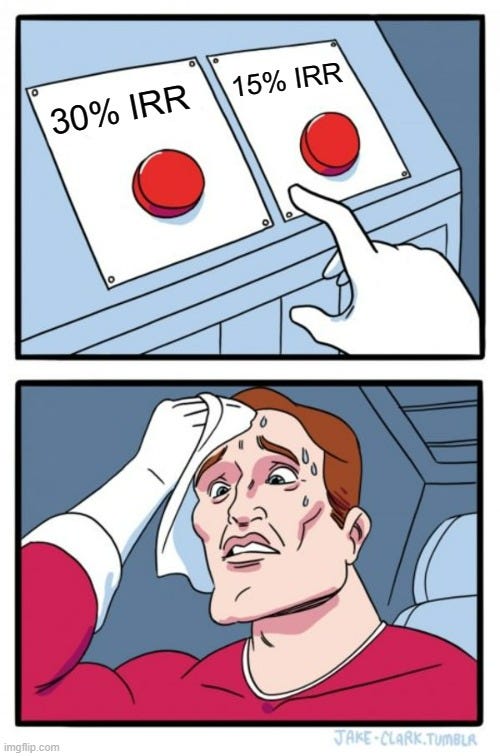
I hear from LPs weekly who filter deals by IRR or other similar metrics. Why should you spend time looking at the 12% IRR deal, when you have another one in your inbox that is 30%… right?!
Wrong.
In the vast majority of cases, I think these filtering mechanisms are risky (to the LP) at best and can cause serious principal losses at worst.
Today I’d like to explain why I have such a strong stance on something that seems fairly standard practice among retail LP investors.
The Pitfall of Single Metric Focus
First, let’s establish why an overemphasis on IRR and CoC (Cash on Cash) is a faulty filtering mechanism for a retail LP.
Overemphasis on IRR:
Issue: Relying solely on IRR might filter out conservative GPs and let aggressive ones “through” the filer
Consequence: LPs who don’t get many opportunities may inadvertently take on more risk by choosing to invest out of a “pool” of GPs that tend to be more aggressive in their underwriting assumptions
Missed Opportunities: Conservative deals with potentially better long-term outcomes on a risk adjusted basis will likely be overlooked
Overemphasis on CoC Return:
Issue: Filtering deals based solely on high CoC Return can favor investments with higher short-term returns but potentially higher overall risks or lower long-term growth.
As a side note, always look out for how cash distributions are made - just because the LLC is distributing cash immediately doesn’t mean it’s from the operations of the property… in some cases it’s taken from equity that was fundraised prior to close
Consequence: This approach might exclude deals with solid fundamentals but lower initial cash returns.
Missed Opportunities: Investments with strong long-term appreciation (which would certainly include basically all value add deals) potential may be overlooked in favor of deals with high immediate returns
To summarize, if you get dozens of deals from different GPs per day (like an institutional investor or allocator would) and you're just overwhelmed with way too much deal flow, you can certainly use metrics to "filter down" to a smaller set of opportunities. But (!!) most retail LPs don't get that many opportunities and, as a result, what ends up happening is they inadvertently take on more risk by having a bias (or “filtering in”) the deals with a higher IRR.
Now, you might ask - fairly - shouldn’t there be an IRR floor of some sort?! In other words, if a private syndication isn’t at least a x% IRR, I shouldn’t even bother!
I think the answer to that is fairly personal, but I would guide you to 10% as an IRR floor benchmark. For more on this topic, I would recommend reading:
While we’re on the topic of IRR, I’d also like to make 2 more points that should help you when looking at investment opportunities.
1) The Importance of Understanding Deal Catalysts
When you’re looking at any deal, try to understand at least three catalysts that could significantly impact the presented IRR in a negative way. This helps you understand downside risk, which is critical in syndicated investments.
If you can't fully evaluate these factors (whether due to time or education constraints), it's okay to pass on the deal and wait for one you can analyze more thoroughly. I give you permission to wait, even if it’s hard to keep your cash under your pillow (hopefully at least treasuries!) in the interim. 😊
2) IRR Calculation: A Sensitivity Analysis
Conduct your own IRR calculation to understand its sensitivity as well. Assess how much of the IRR depends on the exit value versus cash flows. In value-add deals, the majority of the IRR often comes from the exit value, which is why it’s critical to ask for sensitivity tables and understand the assumptions behind the exit projections in deals.
Ideally the above analysis is done on the deal that’s in front of you, but I would start by creating a simple spreadsheet with fake numbers so you can understand how small changes to assumptions have outsized impacts on IRR. You will never be able to unsee this and it’ll change the way you look at IRRs forever - in a good way!
So, in summary, by diversifying your focus beyond single metrics and taking the time to understand the catalysts and sensitivities in each deal, you can make more informed, balanced investment decisions.
I hope this was helpful! As always, would love to hear any questions or comments and wishing you a wonderful week ahead.
I advise LPs on existing and potential positions and write articles here weekly on what I see in the marketplace that could help you invest better. You can find me on LinkedIn or Twitter.
Whether you’re an LP, want to learn to become one, or affiliated with LPs (GPs, Attorneys, CPAs, Financial Advisors) I hope you’ll consider subscribing and sharing this post to help others make more informed investment decisions.
When you’re ready, I could help you in 3 ways - simply reply to this email if one is of interest:
Limited Partners:
Potential positions - you’re considering investing and need an independent opinion
Existing positions - there’s a lack of communication, you’re concerned about fraud, or perhaps you got a capital call request and you’re not sure how to proceed. I have also helped LPs with a “post-mortem” analysis on deals that didn’t work out - it’s important to learn these lessons as opposed to just blaming the GP.
LP Course - review 4 separate memos in 4 weeks together with me and other LPs to learn how to find good LP investments.
LP Topics Seminar** - **an ongoing biweekly 1 hour meeting with other LPs where we'll go over investment decks, capital calls, distressed situations, and modeling. This is meant to provide a deeper look into existing LP investments. Please reply to this email if you’re interested.
***LP Community - ***free 2,200+ member LP Investor community on Twitter
***Find GPs ***in unique asset classes/geographies on my monthly intro post (see LinkedIn’s post as well for more)
General Partners:
Deck review - I’ll look over your marketing materials from the perspective of an LP and provide slide by slide commentary to improve your pitch
Investment review - I’ll provide independent feedback on an opportunity you’re pursuing
Capital call advisory** - **you suspect that you’ll need to make a capital call, but aren’t sure how to proceed or communicate the message.
Other - anything from waterfall/fee advisory to disagreements between co-GPs on the proper path given a set of circumstances
General Consulting: modeling, strategic advisory, underwriting training, etc.
If you’d like to speak on the phone, you can reach me at aleksey@hey.com.
Join GP-LP Match
Sign up, then tell Sloan, our concierge, what you invest in. Sloan brings you sponsors whose raises fit, and your identity stays private until you say yes.
Message SloanNo cut of the capital you deploy.